REVIEWING AND UNBOXING THE TOOCKI USB-C RIGHT ANGLE 1.2M CABLE
May 12, 2026 / by Marco / Categories : Business, Technology
USB C cables are among the most ordinary accessories we own, yet they can make a surprisingly noticeable difference to how comfortable our devices are to use while charging. The Toocki USB C right angle cable is a good example of a simple accessory that tries to solve a very common irritation, because instead of having the connector point straight out from the bottom or side of a phone, tablet, controller, or other device, it bends neatly to the side. That small design change can make charging feel much less awkward, especially when you are holding a phone, using a power bank, gaming, watching videos in bed, or trying to keep a desk setup tidy.
In the video, the cable is introduced in a casual and honest way, starting with a small moment of uncertainty about the brand pronunciation. Whether you read it as Toocki, Tukchi, or something similar, the important point is that this is a budget friendly charging cable with a distinctive connector design. It is not presented as a complicated gadget or a premium tech product that needs an elaborate setup. It is simply unboxed, plugged into a power bank, connected to a mobile phone, and tested to see whether it does what it is supposed to do. That makes the review useful, because with charging cables, the first question is often the most basic one: does it work reliably when you plug it in?
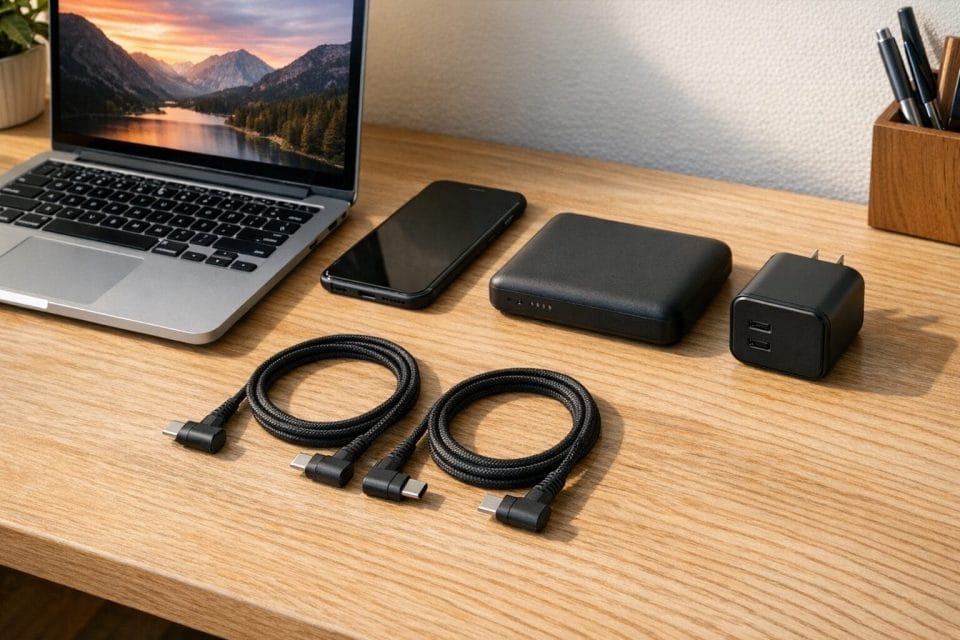
The product shown in the video appears to come as a pack of two cables, which immediately improves its practical value. Most people do not need only one spare cable, because cables tend to migrate around the house, disappear into bags, stay beside the bed, or end up permanently attached to a charger near the sofa. Having two identical right angle cables means one can be kept in a travel pouch while the other stays at home, or one can be used with a power bank while the other remains connected to a wall charger. The title refers to the 1.2 metre version, while the video also mentions a longer 2 metre cable, so it is worth checking the exact listing before buying, since Toocki cables are often available in different lengths and packs depending on the seller.
FIRST IMPRESSIONS OF THE CABLE AND CONNECTORS
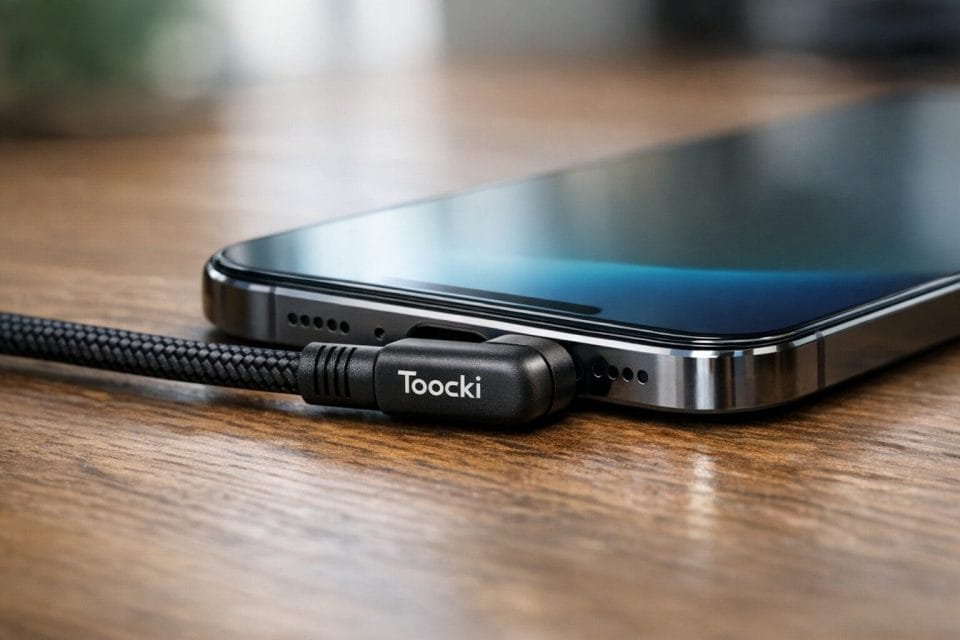
The most noticeable feature is the right angled USB C connector. A normal USB C cable points directly outwards when plugged into a phone, which can be annoying if you are holding the device in landscape mode, resting it against your body, or using it while it charges from a power bank in your pocket. A right angle connector changes the direction of the cable so that it runs alongside the device rather than sticking straight out. This creates a cleaner profile and reduces the amount of space needed around the charging port, which can be especially helpful in tight spaces such as a car console, a backpack pocket, a bedside table, or a gaming setup.
The other end of the cable shown in the video is a USB A connector, which makes it compatible with a huge number of existing chargers, power banks, desktop computers, car adapters, and older charging bricks. While newer chargers increasingly use USB C output ports, many people still have several USB A chargers around the house, and a cable like this is useful if you want to keep using them rather than replacing everything at once. This is a practical choice for everyday charging, particularly if you already own power banks or multi port chargers that still rely on USB A outputs.
In the unboxing, the packaging is not treated as the main attraction, and that feels appropriate. Most charging cables are not bought for a luxury unboxing experience; they are bought because someone needs a dependable cable that is long enough, flexible enough, and convenient enough for daily use. The video quickly moves from showing the packet to displaying the connectors, which is exactly where the attention should be. A cable can look impressive in a product listing, but what matters is how the plug fits into a real device, how the cable routes around the phone, and whether the phone recognises the charge immediately.
The right angle connector looks especially useful for mobile phones because it reduces the visual bulk around the charging port. When a straight connector is plugged into a phone, it can feel like a small handle jutting out from the device, and that puts extra leverage on the port if the cable is bent or bumped. With a right angle design, the cable naturally follows the edge of the phone, which can make the connection feel less intrusive. This does not mean the cable should be pulled or twisted carelessly, but it does mean the physical layout is more comfortable for many common charging situations.
WHY A RIGHT ANGLE USB C CABLE IS USEFUL
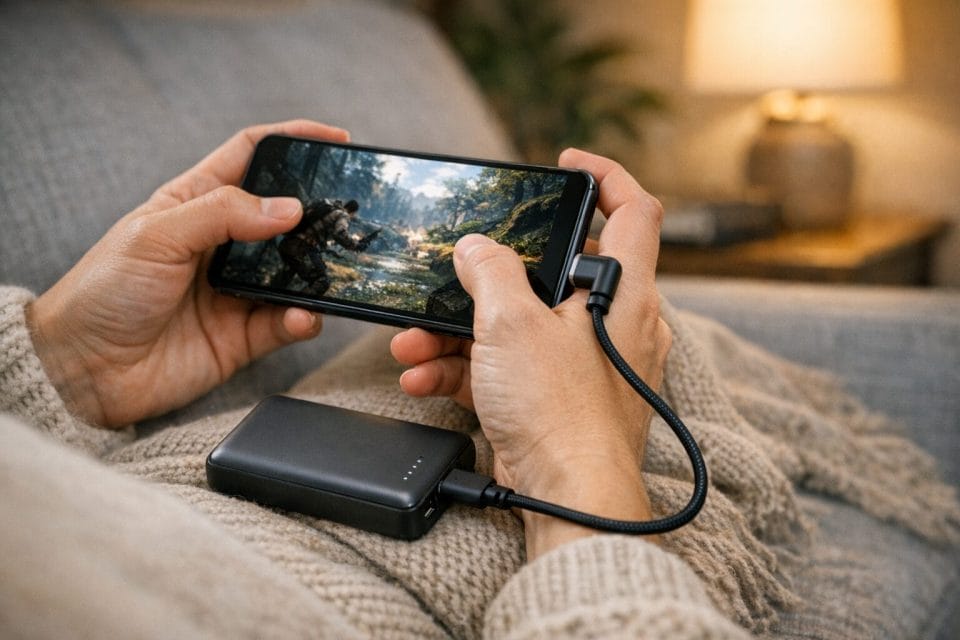
The right angle design is more than a cosmetic difference. It changes how the cable behaves during normal use, and that can matter more than expected. If you have ever tried to charge a phone while watching a film in landscape orientation, you will know how a straight cable can press into your hand or interfere with the way you grip the device. The angled connector moves the cable away from the grip area and lets it rest more naturally along the side of the phone. For people who play mobile games, stream videos, or use their phone for long video calls, this can make the experience noticeably more comfortable.
It is also useful when charging from a power bank. In the video, the USB A end is plugged into a power bank for testing, and that is one of the most realistic ways to use this cable. Many people charge their phone from a portable battery while travelling, commuting, attending events, or sitting away from a wall socket. A straight cable can stick out awkwardly from a phone inside a bag or pocket, increasing the chance of pressure on the connector. A right angle cable can help the phone and power bank sit closer together, reducing cable strain and making the setup easier to carry.
Another benefit is tidiness. Cables rarely stay exactly where we want them, especially on desks, bedside tables, and entertainment setups, so any design that helps guide the cable in a cleaner direction is welcome. A right angle connector can make the cable follow the edge of a device or table more naturally, which can reduce the messy loop that often appears when a straight connector sticks outward before bending back. This is not the same as proper cable management, but it contributes to a neater setup without requiring clips, ties, or extra accessories.
There is also the matter of port protection. A charging port is one of the most used parts of a phone, and although modern USB C ports are designed to handle repeated plugging and unplugging, they still do not enjoy being pulled sideways. A right angle connector may reduce some of the leverage placed on the port in certain positions, particularly if the cable is being used while the phone is held or moved. It is not a guarantee against damage, and no cable can protect a phone from rough handling, but the angled layout can make accidental pressure less severe in some everyday situations.
TESTING THE TOOCKI CABLE WITH A POWER BANK AND PHONE
The actual test shown in the video is straightforward, which is ideal for a cable review. The USB A end is plugged into a power bank, and the right angled USB C end is plugged into a mobile phone. The phone begins charging, confirming that the cable is functioning correctly in a basic charging scenario. There is no complicated software, no pairing process, no driver installation, and no special setup. It behaves exactly as a charging cable should: connect one end to a power source, connect the other end to the device, and watch for the charging indicator.
This kind of test is useful because it reflects how most people will judge the cable when it arrives. They will take it out of the packet, plug it into a charger or power bank, attach it to their phone, and expect it to work immediately. In this case, the cable passes that basic test. The video also highlights how the right angled connector sits once inserted into the phone. It does not extend out as much as a straight cable, and the shape of the connector means it looks less intrusive. The phone can still be handled without the cable dominating the bottom edge or side of the device.
It is important to understand what this simple test confirms and what it does not confirm. It confirms that the cable can provide power from a USB A source to a USB C phone, and it confirms that the connector fits properly in the tested device. It does not fully confirm the maximum charging speed, long duration durability, data transfer quality, or compatibility with every fast charging standard. Those details would require additional testing with a power meter, multiple chargers, different devices, and longer observation. However, for many buyers who simply want a convenient spare cable for everyday charging, the basic result is still meaningful.
The video does not show a detailed charging speed measurement, so it would be wise to treat the cable as a practical everyday charging accessory rather than assume it will deliver the very fastest performance your phone supports. Some USB A to USB C cables can support respectable charging speeds, depending on the charger, device, and cable design, but the exact output can vary. If you need a cable specifically for high watt charging, laptop charging, or advanced data use, you should check the manufacturer details carefully. If your main requirement is charging a phone from a power bank or standard charger, this type of cable is likely to be much more suitable.
The length also matters. A 1.2 metre cable is often a comfortable middle ground for general use because it is long enough to reach from a wall socket to a bedside table or from a power bank to your hand, yet it is not so long that it becomes difficult to coil and carry. A 2 metre cable, which is also mentioned in the video, is better for situations where the socket is far away, such as behind furniture or across a desk, but it can be more cumbersome for travel. If the listing offers multiple sizes, the best choice depends on whether you value portability or reach.
DAY TO DAY COMFORT AND PRACTICAL USE
One of the strongest arguments for this cable is comfort during use. Many people use their phone while charging, even if it is not always ideal for battery heat or charging speed. The reality is that phones are used for everything from messaging and navigation to banking, videos, calls, and entertainment, so a charging cable that gets in the way can become irritating quickly. A right angle connector makes the charging setup feel more natural because it allows the cable to sit closer to the phone body, which is particularly helpful when the phone is being held horizontally.
For bedside charging, the angled connector can also be convenient. If your phone rests on a bedside table while charging overnight, a straight cable may press against the wall, the side of the table, or other objects. With a right angle cable, the wire can run to the side more neatly, reducing clutter and making it less likely to be bent sharply. This is especially useful if the phone is placed in a stand or tucked into a narrow space. It can also help keep the cable from hanging awkwardly over the edge of the table, depending on the direction of the angled connector and the location of the charging port.
For travel, the cable has a different kind of appeal. Power banks are most useful when they are easy to manage, and cable length and connector shape both influence that experience. A shorter or medium length version can be easier to use on trains, planes, buses, and in cafés, while the right angle connector can keep the phone and power bank closer together in a bag. If you regularly charge your phone while walking around, the connector design may reduce the feeling that the cable is sticking out in a vulnerable way.
There are also possible advantages for car use. Many cars still have USB A ports, and a USB A to USB C cable can be useful for charging phones, connecting to infotainment systems, or powering small accessories. A right angle connector can help the cable sit more neatly around a dashboard mount or centre console, especially when space around the phone holder is limited. As always, compatibility with data functions such as Android Auto depends on the cable and the vehicle, so buyers who need data support should verify that the cable is suitable for more than charging.
The cable may also appeal to people who use accessories such as handheld gaming controllers, wireless earbuds cases, small tablets, cameras, or portable speakers that charge through USB C. A right angle connector is not always necessary for these devices, but it can be useful when the charging port is positioned in an awkward place. For example, a small speaker can sit more stable on a shelf when the cable runs sideways rather than straight out, and a controller can feel better in the hands if the cable is routed away from the grip area.
WHAT TO CHECK BEFORE BUYING
Although the Toocki right angle cable works in the simple charging test shown in the video, it is still worth checking a few details before purchasing. The first is connector orientation. A right angle connector can point in different directions depending on how the cable is designed and how your device port is positioned. On some phones, the cable may route to the left, while on others it may route to the right depending on whether the device is facing up or down. This usually does not matter for casual charging, but it can matter if you want the cable to follow a specific direction in a phone holder, gaming grip, or desk setup.
The second point is cable length. The title highlights a 1.2 metre cable, while the video mentions a cable that appears to be 2 metres, so buyers should look carefully at the product option they are selecting. A 1.2 metre cable is a sensible size for carrying around and using near a power bank, while a longer cable is better if you need distance from a socket. It is easy to underestimate how much length you need until you try to use a cable beside a bed, behind a sofa, or in a car, so it can be helpful to think about where the cable will live most of the time.
The third point is charging performance. If you only need to top up a phone, a basic USB A to USB C cable is usually adequate, provided it is built to a reasonable standard. If you expect very fast charging, data transfer, or use with larger devices, you should read the product specifications carefully. Not all USB C cables are equal, and the connector shape does not tell you everything about the internal wiring or supported power levels. For phones and power banks, this cable type is convenient, but for laptops and high power devices, a USB C to USB C cable with clearly stated wattage support may be more appropriate.
The fourth point is build quality. The transcript does not go into detail about the cable material, outer texture, strain relief, or internal construction, so it is difficult to make a firm judgement from the unboxing alone. However, with any cable, the areas near the connectors are the most important because that is where bending and pulling usually happen. A right angle connector can reduce some awkward bending, but the cable still needs to be treated with care. Avoid pulling it out by the wire, avoid sharply folding it, and avoid leaving it under heavy objects if you want it to last longer.
The fifth point is device case compatibility. Some phone cases have thick edges around the charging port, and although USB C connectors are generally compact, a wider angled housing may not fit every case perfectly. If your phone has a rugged case, a wallet case, or a case with a deep charging port cutout, it is worth checking reviews or product images to see how large the connector housing is. In many cases it will fit without issue, but this is one of those small details that can decide whether a cable feels perfect or frustrating.
WHY THIS SMALL CABLE UPGRADE MAKES SENSE
The Toocki USB C right angle cable is not trying to reinvent charging, and that is part of its appeal. It takes a familiar cable format, adds a more practical connector shape, and makes everyday charging a little more comfortable. The video demonstrates the most important basic point clearly: the USB A end plugs into a power bank, the right angled USB C end plugs into a phone, and the phone begins charging. That simple result is enough to show that the cable works for the kind of everyday use most buyers will have in mind.
Its real value comes from the convenience of the angled connector. If you charge your phone while holding it, use a power bank often, keep a cable beside your bed, or want a neater setup on a desk or in a car, the right angle design can make a small but noticeable difference. The cable does not stick out as far from the device, the wire can route more naturally, and the charging experience feels less awkward. For a low cost accessory, that is a worthwhile improvement.
The main advice is to choose the length carefully, check whether the listing is for one cable or a pack of two, and confirm that the cable suits your charging needs. If you need advanced charging speeds or data performance, look closely at the specifications before relying on it as your main cable. If you simply want a handy USB A to USB C cable that is easier to use with a phone and power bank, the Toocki right angle cable shown in the video looks like a practical and sensible option that solves a real everyday annoyance without making the purchase complicated.

Marco / admin / 30 Nov
Writing day to day ramblings about making money, business, technology, sharing awesome deals and everything else that I know I'll forget. Follow my personal blog https://marcotran.com.au
I've recently also turned Vegan and started this website Veggie Meals - check it out
"When technology speaks for itself, that is art" - MT
Affiliate Compensated: there are some articles with links to products or services that I may receive a commission.
OTHER ARTICLES YOU MAY LIKE

USING THE LATEST CLAUDE MODEL TO BUILD GREAT TOOLS
If you have ever had an idea for a small tool but stopped because coding felt too hard, the latest Claude model makes that gap much smaller. You can now describe what you want in plain English, ask Claude to plan it, build the first version, improve the design, write the logic, test the workflow, […]
read more
REVIEWING AND UNBOXING THE TOOCKI USB-C RIGHT ANGLE 1.2M CABLE
USB C cables are among the most ordinary accessories we own, yet they can make a surprisingly noticeable difference to how comfortable our devices are to use while charging. The Toocki USB C right angle cable is a good example of a simple accessory that tries to solve a very common irritation, because instead of […]
read more