Naztech Wireless Power Hub 5: Qi-Enabled + 4 USB Ports for $44
March 19, 2020 / by Marco / Categories : Business, deals, design, entrepreneur, website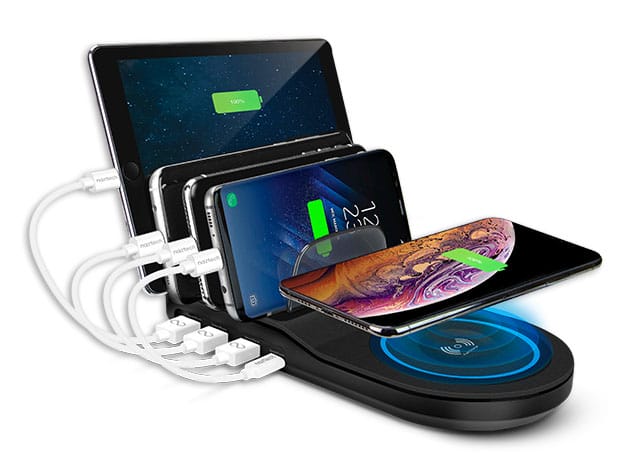


KEY FEATURES
Perfect for the modern multi-device user, the Power Hub 5 features a built-in wireless fast charger and 4 high-speed USB ports. Charge 5 devices at the same time from a single AC outlet! The wireless charger delivers up to 10W, which is ideal to fast charge the latest iPhone and Android devices, and a powerful tablet-friendly 2.4A output from each USB port. The space-saving design fits on any desk or tabletop and individual docking stations will keep all devices neatly arranged while charging. Power everything, all in one place!
- Charge 5 devices simultaneously w/ Qi provision & 4 USB ports
- Fast charge your iPhone or Android device 2x the speed of standard Qi chargers
- Deliver high-speed 2.4A output through each port
- Save space thanks to the individual docking stations
PRODUCT SPECS
Specs
- Color: black
- Materials: plastic, metal
- Product dimensions: 8″ x 4.72″ x 3.3″
- Weight: 15 oz
- AC cord length: 5 ft
- Total output: 35W/7A
- AC input: 100-240V, 50/60Hz
- Qi output: 5W/ 7.5W/ 10W
- USB output: 4x 5V/2.4A (25W max)
- Protection: short circuit, overcharge
- IntelliQ Smart Chip
- Individual docking stations
- Travel-friendly
- Manufacturer’s 2-year warranty
Compatibility
- Check compatible devices here
Includes
- Naztech Wireless Power Hub 5
- 5x Acrylic Dividers
- AC Power Cord
- User Manual

Marco / admin / 30 Nov
Writing day to day ramblings about making money, business, technology, sharing awesome deals and everything else that I know I'll forget. Follow my personal blog https://marcotran.com.au
I've recently also turned Vegan and started this website Veggie Meals - check it out
"When technology speaks for itself, that is art" - MT
Affiliate Compensated: there are some articles with links to products or services that I may receive a commission.
OTHER ARTICLES YOU MAY LIKE

USING THE LATEST CLAUDE MODEL TO BUILD GREAT TOOLS
If you have ever had an idea for a small tool but stopped because coding felt too hard, the latest Claude model makes that gap much smaller. You can now describe what you want in plain English, ask Claude to plan it, build the first version, improve the design, write the logic, test the workflow, […]
read more
REVIEWING AND UNBOXING THE TOOCKI USB-C RIGHT ANGLE 1.2M CABLE
USB C cables are among the most ordinary accessories we own, yet they can make a surprisingly noticeable difference to how comfortable our devices are to use while charging. The Toocki USB C right angle cable is a good example of a simple accessory that tries to solve a very common irritation, because instead of […]
read more